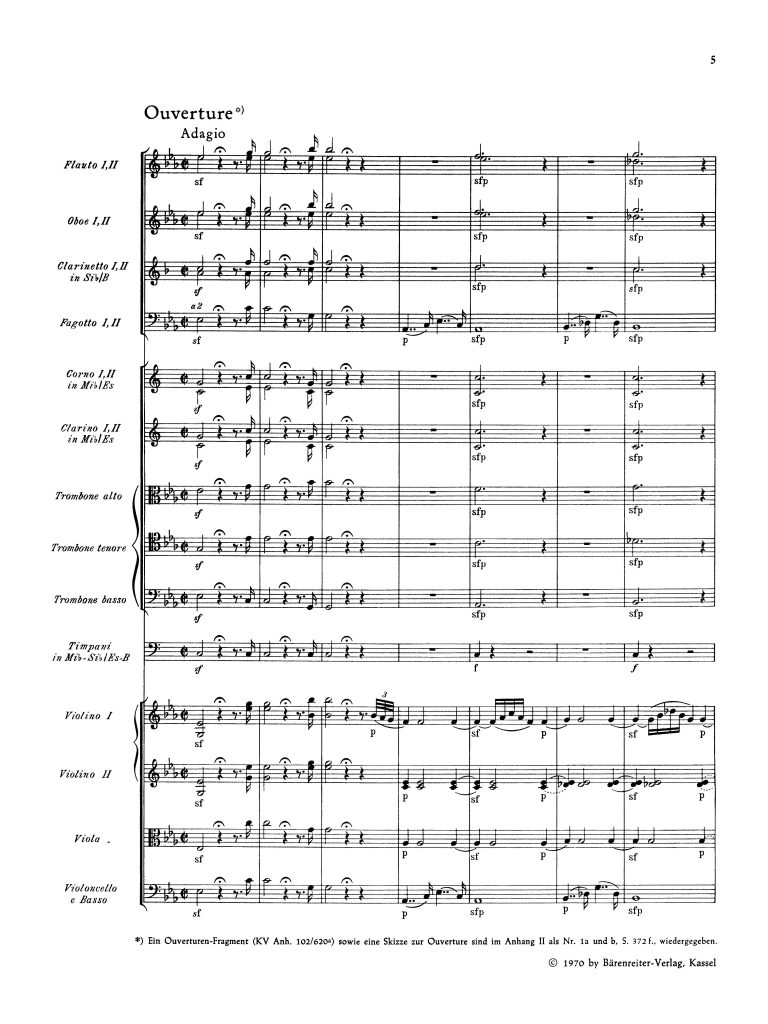
A recent post on a Facebook conductors group about the tempo connection between the Adagio and Allegro in Mozart’s overture to Die Zauberflöte drew a great deal of comment about the opening of this piece. Although not the only matter with which I would be inclined to take issue, there was one proposition I found particularly disturbing:
- Because it is marked alla breve, the Adagio must be conducted using a pattern of two
This proposition garnered some support, but to me it is not merely misguided: such an approach prohibits any possibility of obtaining results which could be in any way pleasing to the ear. This is essentially because, and irrespective of the tempo, this is music which will always sound better if approached from a basis pattern of four. And surely, the crucial point for conductors must always be sound, not some kind of strange dogma?
So why does Mozart demand alla breve and how do we justify doing something else? In this article I will attempt to give a relatively short answer.
Time signatures
It seems surprising that there can be people who are unaware of this, but time signatures arose long before conducting. Consequently the idea that we must use the upper integer to denote a movement pattern is simple to contest: time signatures are not instructions for conductors, they merely provide information about the music which we are required to consider not some form of command to take literally in respect of gesture.
Even if this were not the case though, then the musical repertoire itself shows that it would be somewhat bizarre to take a dogmatic approach concerning the upper integer. If we were to do so then, in the case of Mozart’s Figaro overture, we would be obliged to use a pattern of four to realise this thrilling presto, a proposition which I doubt has ever been attempted on the professional stage. Likewise, using the same logic, it would be obligatory to conduct a Beethoven scherzo, or a waltz, from a pattern of plain three. There are countless other examples, but it seems unnecessary to make a fuller list in respect of something so obvious.
It is also a mistake to view a score as a set of instructions. The whole point of a musical score is that it is a representation of imagined sound. We have to consider not the literal nature of what is written but how to understand the information provided. Only then can we establish a credible view about what the score means in terms of sound and gesture.
The time signature is only one small part of this story. One which gives us crucial information about the composers thinking of the pacing and flow of the musical narrative.
Alla breve
So what does alla breve tell us in the context of slow music? I remember finding this one of the great challenges of my early days as a conductor: how to reconcile a proposition of alla breve with music clearly be perceived as moving at a slow tempo (which is not uncommon, particularly in Haydn’s music).
Clearly the time signature and the tempo marking taken together meant something important but in those days I was stuck in the mire of having only two options: to conduct it in two or four. Finally it hardly mattered which, because either way was more-or-less equally frustrating because I was painfully conscious that neither actually worked.
To get to some kind of solution, we always need to think about concept before gesture and here we first need to think generally about slow music works. It is somewhat simplistic but I hope you will agree that in general our sensation of slow moving music arises when we hear sustained line energy (i.e. some kind of melody line) moving over a much slower basis of structure and harmonic rhythm. That is to say, the musical line might move in small units but it moves between wide-spaced structural pillars which provide a sense of calm. Inexperienced conductors struggle with slow music because finding the movements which simultaneously support the dual nature of both the line and the structure without adding undesirable weights in inappropriate places is not simple.
Returning to this particular case, the alla breve gives us a hint about how the music needs to work; that is to say, where the pillars are placed. If we look at the text, in the first three bars there is clearly emphasis only on barlines, from each of which the sound decays.
The fourth bar, however, makes an interesting and beautiful contrast because where previously we had only decay, now the bass line flows towards and away from the middle of the bar. Here, if the music is to sound good, the bass line Ab needs to accumulate energy through the sixteenth C up to the Eb in the middle of the bar. From here the line energy decays but we have another weight at the start of bar 5, from which the energy decays towards bar 6.
Now it is true that this is speculative: Mozart does not give any instruction in this regard. Not even a hint. This view is not, however, only my own. It arises from many discussions of this music with musicians from different countries and backgrounds. Neither I nor anyone I ever spoke to can conceive of any different idea in respect of the essential flow requirement of this bass line and I would be surprised if any cellist, bass player or bassoonist would appreciate being asked to do anything else.
That leads me to that point that, even if you do disagree about this then, if you are any kind of conductor, you should anyway be capable of conducting on the basis of this reasonable proposition of the musical requirements even if you do not specifically agree with them. If this is not the case, how on earth can you ever accompany a soloist?
Returning to the subject at hand, we can conclude that from a group of four half bars (i.e. bars 4 and 5) the rough minimum musical requirements are that we must ensure from the fourth bar:
- That the line energy has a progression towards and away from the middle of bar 4.
- That we create a sense of weight on bars 4, 4.5 and 5 but not at bar 5.5.
- That we take care of the placement and subsidiary weight of the cross rhythms in the violins and violas
Incidentally, it is perhaps worth pointing out that these requirements apply irrespective of the actual tempo. They relate to the way we manage tempo – the essential structure, not the velocity and these are two entirely different matters.
Concerning the alla breve, broadly the same progression applies in the next pair of bars and the music continues in similar vein thereafter. For four bars at least from bar 4, we therefore have weights on three out of four half bars. The time signature which has the clearest relationship with the musical content would be alla breve.
The issues of gesture
If we accept these musical premises as providing a viable relationship to the composer’s requirements of Adagio and alla breve, then perhaps we have a viable basis of concept that we should be able to impart. In that case we can also observe that if we did anything which disturbs, discourages or prevents the musical features discussed, we would be contradicting our own musical proposition. If we were to do that then it would be, at the very least, profoundly unreasonable to stop and ask musicians to comply with our wishes as opposed to our gestures. Nonetheless, it is commonplace to do so, and it is conductors doing this which so many musicians of quality find simply intolerable.
The reason that this piece remains such a challenge and talking point for conductors is because meeting those musical requirements discussed so far is not simple. And that is to say nothing of the countless other difficulties presented by this opening.
Most significantly though, for those whose basis of thinking is that such music is “in two” or “in four” it is plainly impossible to find gestures which can support any viable musical proposition here.
If you are in that situation then the two key propositions which might help are:
- Pattern and weight are things we must be able to connect or disconnect at will. Our patterns should not be heard, only the musical features which fall within them. So we need to be able to show placement without weight and adjust weight so that we can help it to fall anywhere we choose.
- Musical narrative is horizonal, not vertical in its essential nature. consequently, in order to carry the bass line sound to the middle of bar 4, we need to move horizontally.
The latter issue explains why we cannot conduct this from a pattern of two. Irrespective of the tempo, I cannot imagine any way to do this because we need to create increasing bow speed, air and energy flow towards the middle of this bar. The inherent difficult of a pattern of two, especially where the movement is relatively slow, is that the movements are primarily vertical and this creates an inherent issue of sound decaying from the half bars – the exact opposite of what needs to happen here. It is, quite simply, a way of killing the magic!
If we eliminate that possibility, then however reluctant we might be, we are left only with a pattern basis of four. But in this case the first point above is crucial: it cannot be a four comprising evenly-weighted beats, which will kill this music even more effectively than a pattern of two – because, even if the sound is equally poor, the likelihood of a slower tempo means that the process will likely last longer!
What we need to be able to do is to move in such a way that:
- We carefully shape the weight of the second quarter of bar 4, understanding that too little will lose structure and too much will kill the flow
- We accelerate movement through the second quarter to carry the energy to the third quarter of bar 4
- We apply the same rules to the fourth quarter as to the second
- We organise the energy and attack for bar 5, and then take care of the first violin line, in itself a possible subject of all kinds of debate but a matter which is not relevant here.
Tempo
Musical flow and shape are far more significant than tempo. One of the key points about a working scheme such as I describe is that organising gesture on the basis of energy flow and weight allows enormous freedom of choice about the actual tempo. In this case, it becomes possible to conduct the music at the full range of possibility from unbearably slow to comically fast, but in every case retaining the right direction of energy and narrative.
The fact that we are then able to manage a huge range of options for the Adagio in turn allows a huge range of possible connections into the Allegro. On that subject, my view is the the key to finding something convincing is to think carefully about the energy flow through the last note. But the point of this article is to try to show that until the Adagio is working effectively, there can be no meaningful basis of connection.
In terms of working process, the next step is to find a viable basis of operation for the Allegro. Only once we have viable operation of both parts and an understanding of the nature of the musical connection can we consider how to reflect this within gesture.
Of course those are not the only remaining issues and there is a great deal more to discuss about such a piece, but this article is intended only to help those new to it get started on their journey in a fruitful manner. On which note, having thought about this piece for decades, I can tell you that it never gets tiresome.
I hope this is all clear. If you would like to clarify anything please add a comment on this page.
For those interested in discovering more about such masterworks and how to go about the processes of connecting musical ideas with actual sounds as a conductor, the Conductors Academy offers both classes and scholarship support to attend them on the basis of a simple application.
Jonathan Brett
© Jonathan Brett 2026


Leave a Reply